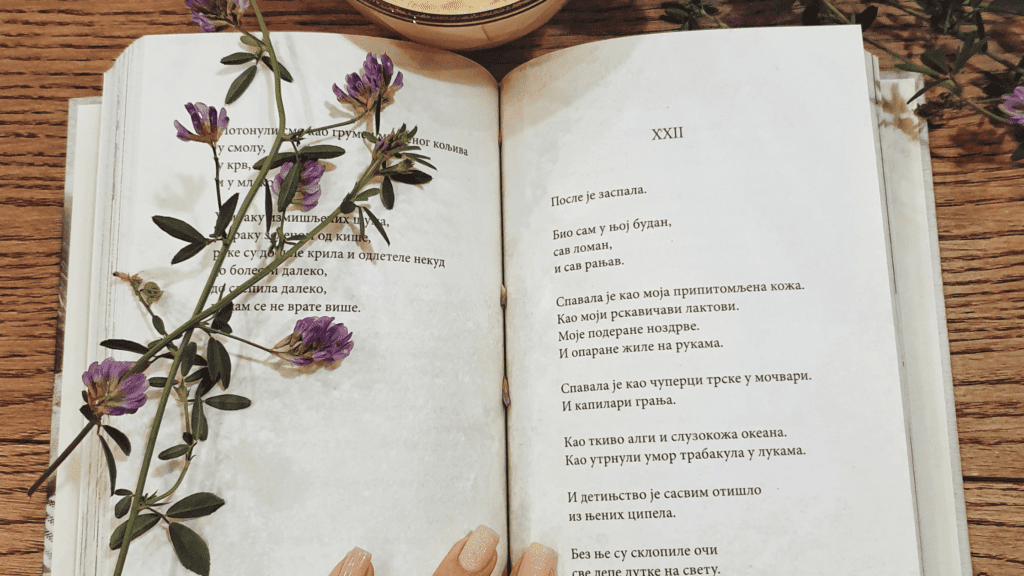
There have been debates about what exactly makes a piece of writing poetry and what makes it different from a quote. It can be confusing as a writer sometimes, when you read over the words you have put down and they start looking a lot like quotes instead.
What makes a group of words poetry? What are the characteristics of a poem? What makes a poem a poem, as I usually like to frame my question?
Though there are different types of poems, over ten types actually, and though each type of poetry has specific features that differentiates it from the rest, there are characteristics that are common to all poems, or at least, most poems. I will be looking at five of these characteristics.
1. Concise Expression
One of the most important characteristics of a poem is how much it can say with so few words.
Unlike stories or essays where you have space to explain things in detail, poetry relies on brevity. Every word in a poem carries weight. There is little to no room for unnecessary words.
A single line in a poem can express a full thought, emotion, or image that might take several sentences in prose to explain. This is what makes poetry powerful. It communicates deeply without saying too much.
2. Organized Sections or Stanzas
Unlike stories, novels and plays where words, scenes and ideas are arranged in paragraphs of many sentences, dialogues, or acts and scenes (in the case of plays), poems are organized specifically into lines which are grouped in stanzas.
The stanzas and lines are written around a central theme and specific subject matter, and as you read, you are able to grasp, just by the few words or lines, what the writer is trying to talk about.
Some poems may have just one stanza, others, two or four or even more. But the most important thing is its organized structure.
Lines of poetry don’t necessarily have to end as complete sentences. That means, a sentence can be broken into a first line and a second line of a poem, with a break that makes sense. Poems also do not need to be punctuated. Punctuating a poem is optional though it does help guide your audience as they read.
Narratives on the other hand, involve paragraphs of continuous lines that end with periods or full stops. There is full use of punctuations as well.
3. Use of Literary Devices and Visual Imagery
Poems make use of a variety of literary devices to create deeper meaning and stronger expression. These devices help transform simple words into something more vivid and memorable.
Common literary devices such as personification, metaphor, simile, hyperbole and onomatopoeia are often used in poetry. They allow writers to go beyond direct statements and express ideas in more creative and layered ways. I explain further in my post on 14 Essential Figures of Speech.
For example, instead of saying “I was very sad,” a poet might write something like “the night sat heavy on my chest.” That single line gives a clearer emotional picture without stating it plainly.
Visual imagery is also a key part of poetry. Through carefully chosen words, a poem can paint scenes, emotions and moments in the reader’s mind. You are not just reading the poem, you are seeing it, hearing it, and sometimes even feeling it.
Good imagery appeals to the senses. It can make you:
- see a place
- hear a sound
- feel a texture
- or even recall a smell or taste
Another important aspect is that many poetic lines carry more than one meaning. A single phrase can have both a literal and a deeper interpretation, depending on how the reader connects with it. This layered meaning is what often makes poetry feel personal and open to different interpretations.
Literary devices and imagery work together to give poetry its depth. Without them, a poem may feel plain or too direct. With them, even a few lines can leave a lasting impression.
4. Emotional Power
One of the strongest characteristics of a poem is its ability to make you feel certain emotions, often in just a few lines.
Unlike other forms of writing that explain emotions, poetry allows the reader to experience them. A poem does not always tell you what to feel directly. Instead, it uses carefully chosen words to create a mood that pulls you in.
A good poem can make you feel heartbreak, joy, loneliness, peace, or even confusion, sometimes all at once. And the interesting part is, two people can read the same poem and walk away with completely different emotions.
Poets achieve this emotional depth in a few ways:
- by choosing words that carry strong emotional weight
- by using imagery that connects with real-life experiences
- by leaving space for the reader to interpret meaning
Sometimes, what is not said in a poem is just as powerful as what is written. A pause, a break in a line, or even a single word can carry a lot of emotion.
5. Rhyme Scheme
Before anything else, it is important to know that not all poems follow a rhyme scheme. Free verse, which is a very common style of poetry today, does not rely on rhyming patterns at all.
That said, many traditional poems do make use of rhyme schemes to create rhythm and structure.
A rhyme scheme is the pattern of rhyming words at the end of lines in a poem. These patterns are often represented using letters like AABB or ABAB, where lines that share the same letter rhyme with each other.
For example, in an AABB rhyme scheme, the first two lines rhyme with each other, and the next two lines form another pair of rhymes.
A good example is Robert Frost’s Stopping by Woods on a Snowy Evening:
Whose woods these are I think I know.   (A)
His house is in the village, though;   (A)
He will not see me stopping here   (B)
To watch his woods fill up with snow.   (B)

My little horse must think it queer  (C)
To stop without a farmhouse near  (C)
Between the woods and frozen lake  (D)
The darkest evening of the year.  (D)
Rhyme schemes can make a poem more musical and easier to remember.
However, it is important to remember that rhyme is not what defines poetry. Many modern poems do not use rhyme at all and still carry meaning and emotional depth. So while rhyme schemes are common in poetry, they are not a requirement.
Thanks for reading! I hope this was helpful.
Do subscribe to receive updates on new blog posts, and don’t forget to follow on Pinterest for more writing tips.